A good cookware should make it easy for you to cook your favorite meal but also it must be a great platform to cook the meal as safely as possible. Hence, the need for Ceramic vs Teflon cookware comparison.
I will show you the practical features, pros, cons, and comparison of the two most highly regarded nonstick cookware available in the market. These two materials are really taking over from the dominant stainless steel material for cookware.
Let me quickly run through the features in a way that would make it easier for you to make decisions afterward.
More...
Post Navigation
Ceramic
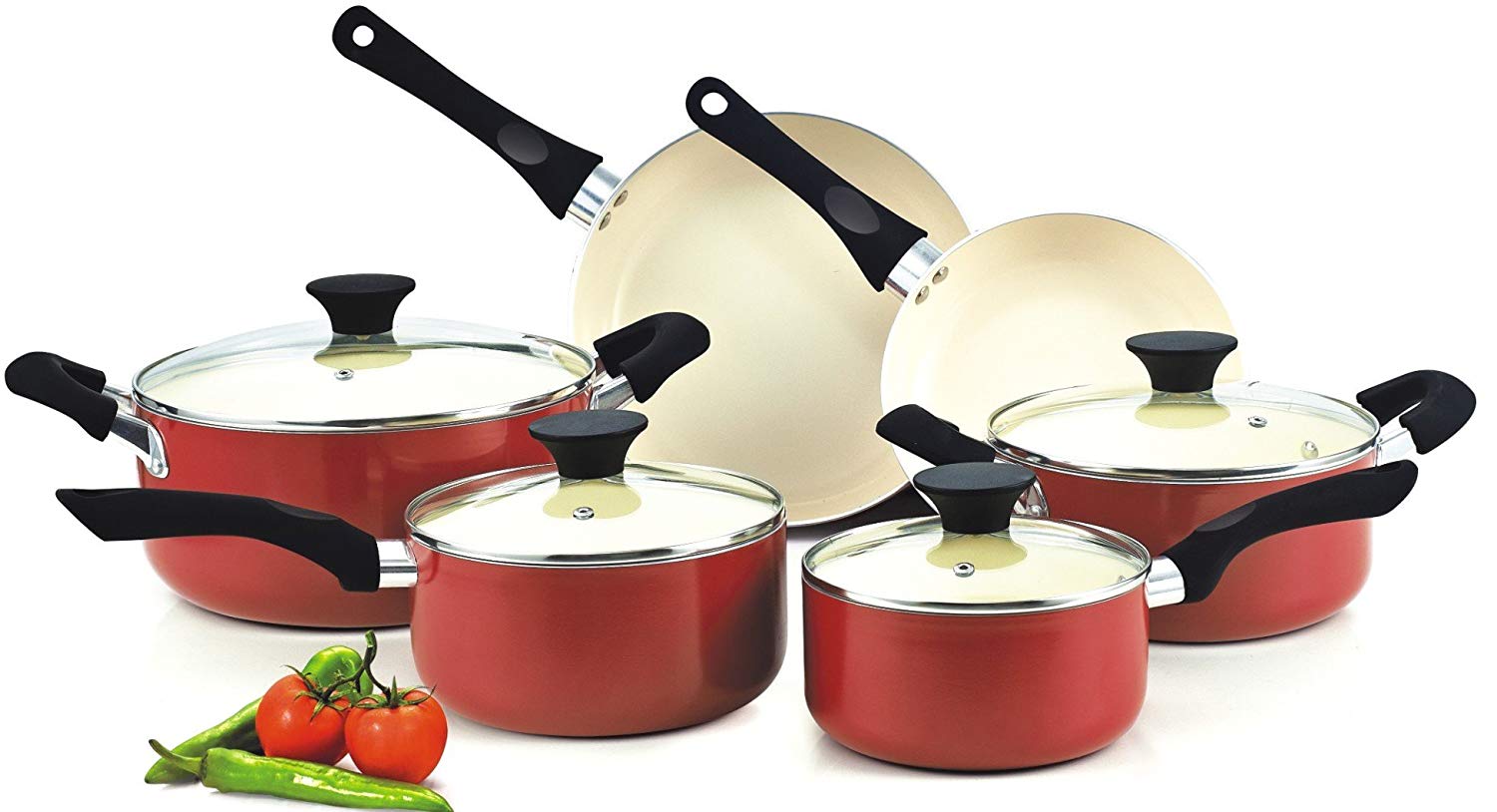
There have been lots of use for ceramics in time past. It was recently that technological advancement caught up with the quality features of this material, hence the transition to a very powerful cookware for you.
Due to the demand of users for a nonstick cookware and the cons that comes with the Teflon cookware, the ceramic cookware has found their way to the kitchen of many homes. This has invariably made it a popular name when it comes to safe nonstick cookware.
Pros
Nonstick: The most important feature of the ceramic cookware is its nonstick ability. This is so important for chefs because it mitigates the possibility of foods getting burnt and the unnecessary coating with oil and butter which invariably reduces calories intake through food.
Toxic Free: Regardless of the temperature with which you cook or preheats the ceramics, you are guaranteed to have a food that does not compromise on the safety of your health and that of the environment. Ceramic doesn’t emanate any kind of dangerous fumes while in use.

Ease of Maintenance: Because of its nonstick property, it is very easy to clean without tampering with the quality of the material used in producing it. That is, you can simply make use of wet or damp cloth to remove residues that are present after use. You don’t need to scrub the surface of the ceramic cookware before you get a clean surface.
Pricing: Most of the cookware made from ceramic do not come with an exorbitant price that would scare you away from acquiring it to your kitchen's list. Getting a 10-set quality ceramic cookware for less than the $100 benchmark shows that it is a very affordable piece to acquire.
Cons
A typical ceramic has a short lifespan when compared to other cookware materials available in the market. The durability of the nonstick coating of the ceramic has always been the source of concern for users. Once the coating wears off, it removes its nonstick ability and hence rendering the whole cookware ineffective for one of its primary features that made you acquire it in the first place.

Via Leaf.vn
As easy as it is to clean your ceramic cookware, it is very important to note that you cannot clean it using a dishwasher. Hence, it is limited to hand washing to improve its longevity.

Via Leaf.vn
Just because it doesn’t bring out dangerous fumes when you cook at a higher temperature does not necessarily means it is suitable for high-temperature cooking. Ceramic has heat limitation level, hence, high-temperature tempers with the coating which invariably destroys it after a short while.
The weight of the ceramic is light which doesn't make it a sturdy cookware option.
Teflon

The main and focal point of a typical modern cookware lies in its nonstick ability.
Manufacturers understand this customer’s needs and were able to quickly tap into it through the use of Teflon materials.
Though it was originally used as a coat on cookware to provide them with improved strength, it has been seen that it does have a quality and strong nonstick ability which has since being utilized in manufacturing cookware.
The strength of its carbon-fluorine bond is responsible for the non-reactive property that comes with cookware.
Pros
Nonstick: Teflon is regarded as the king of cookware due to its nonstick nature. Teflon showed customers that there is a possibility of cooking and frying without having to coat the surface of the pans with oils and margarine and this has, in turn, reduce the intake of calories – making it healthy for use. Food rarely burns in a Teflon cookware due to this great feature.
Easy to Clean: If you have cookware that is produced using this material, you will undoubtedly agree with me that you don’t have to scrub the surface before you remove residue after use. Its hand washing and dishwashing compatibility without compromising on the quality of the Teflon used is top notch.

Strength and Sturdiness: The material (Teflon) actually gives cookware a very reasonable strength for balance and sturdiness which has become important over time for the stability of the cookware.
Cons
The greatest disadvantage of Teflon is the dangerous fumes that emanate from the surface of the cookware when it is being overheated or preheated. This fume has been said to be against the environmental protection law. Hence, the addition of other materials has been utilized by manufacturers to reduce the dangers of this fume. This has given birth to Hard-anodized Teflon and Stainless steel Teflon
The use of metal and sharp utensils on the Teflon cookware has a high tendency of scratching the surface of the cookware. Hence, it is advisable that you make use of wooden spoons and other utensils for stirring the contents of the cookware.
Conclusion
After taking the stress to make obvious the pros and cons associated with both ceramic and Teflon cookware, it is really important to make it known that you have to weigh the pros and cons individually before coming up with the better cookware option.

Via Ecookware
Both ceramic and Teflon are not good with high heat, though Teflon emanates dangerous fumes which is not good for the environment and you as well.
In my own view, I would prefer Teflon due to its more sturdiness, longevity and the dishwashing ability that comes with it. Ceramic doesn’t possess these high-end features that make for the best cookware material.
Related Articles:
Leave a Reply